


Supreme Lifeline CPVC is manufactured using Japanese material and technology. The solvent cement used for jointing is NSF approved and manufactured by Supreme itself not sourced externally ensuring consistent joint quality and system integrity. The system carries both NSF USA and CFTRI approvals and conforms to IS 15778 for pipes and IS 17546 for fittings.
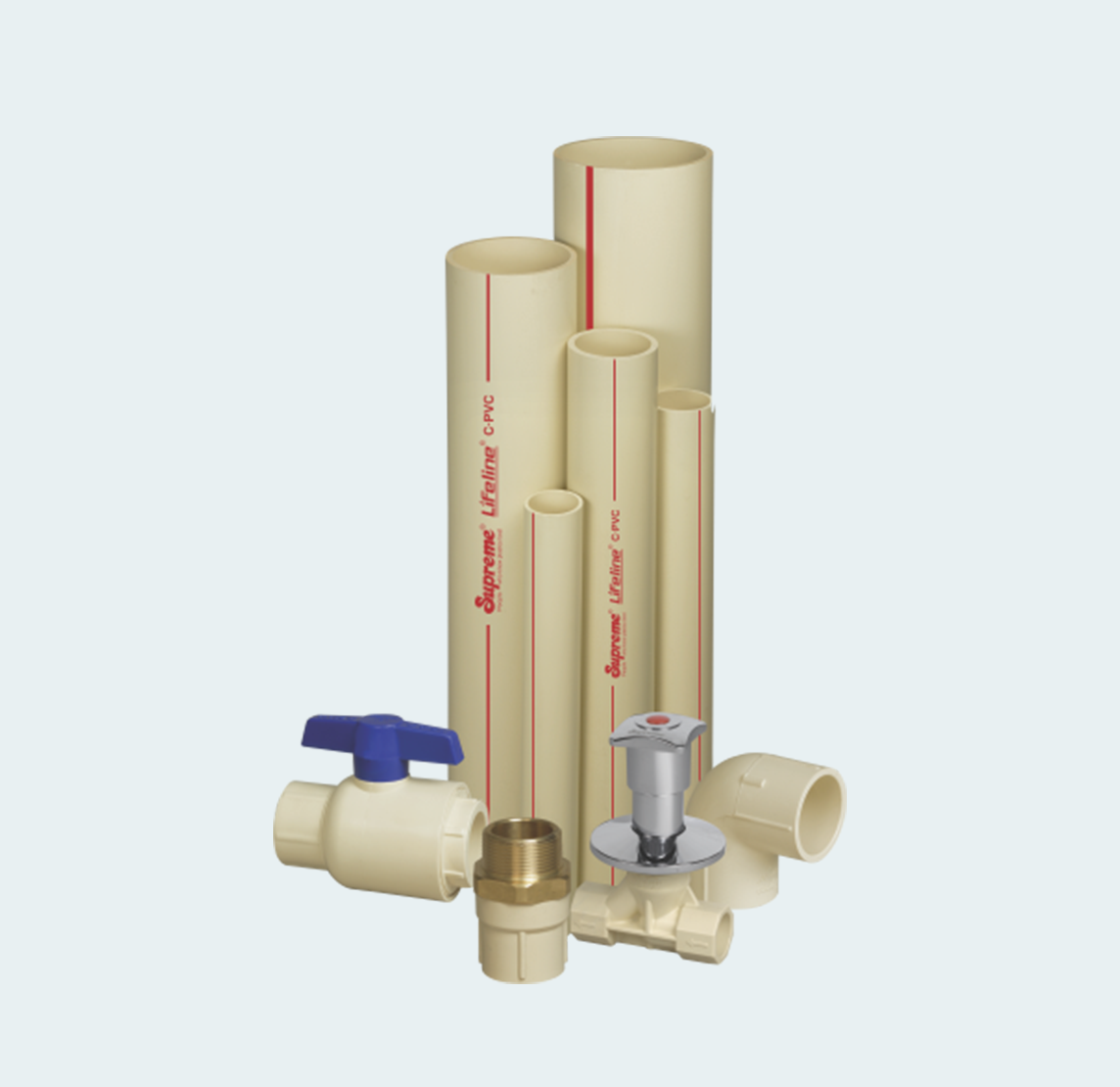
Lifeline CPVC Hot & Cold Water - CTS Series
Lifeline C-PVC, cpvc pipes and fittings, are designed for hot and cold water supply in residential, commercial and public projects, high and low rise buildings, corporate houses and academic institutes, solar heater applications, etc. CPVC pipes and CPVC pipe fittings are suitable for all uptakes and down take lines, terrace looping, and concealed pipe work applications. The choice of the raw material, the structural accuracy, and the strict quality control impart a high degree of reliability to Supreme Lifeline C-PVC. Lifeline is the most suitable, easy, and economic solution for the transportation and distribution of potable water. Available as one of the best cpvc pipes in India, it is technically much superior and offers many advantages over GI and other conventional systems.
Supreme offers CPVC hot water pipe and CPVC cold pipe series - Lifeline C-PVC pipes are available from ½” to 2” sizes in SDR 11 and SDR 13.5 pressure classes, conforming to IS 15778. CPVC pipe fittings and Lifeline C-PVC pipes are available from ½” to 2” sizes in SDR 11 pressure class as per ASTM D – 2846. High pressure class pipes and fittings in ¾” and 1” sizes in SDR 9 are also available as per company standard.

FILTER
No products available.
- High quality and wide range - The system consists of CPVC pipes and a wide range of fittings with company-manufactured, NSF-approved international quality solvent cement, which makes the system complete in all respect.
- Excellent resistance to corrosion and chemical attacks - Lifeline® is completely free from corrosion and offers excellent resistance to a great number of chemicals like strong mineral acids and bases, making it ideal for plumbing fittings.
- Most suitable for carrying potable water - Being free from corrosion, Supreme pipes have no negative biological effects and does not break down even under the harshest water conditions. It does not let the quality of water deteriorates, ensuring safe usage in plumbing accessories.
- Lightweight, easy and quick assembly - Lightweight and simple solvent cement jointing methods used in Supreme CPVC pipes result in extensive savings on time, labour, and costs.
- Tough and rigid material - C-PVC has a much higher strength modulus than other thermoplastics used in plumbing applications. Due to its tough and rigid material properties, Lifeline® can withstand higher pressure and temperatures. It requires lesser support with minimum offsets/looping. Hence CPVC hot water pipe is the best choice for high pressure/temperature.
- Leakproof joints - Jointing with special solvent cement manufactured and supplied by the Company ensures 100% leakproof joints in Supreme CPVC pipes, ensuring durability in CPVC fittings.
- Low thermal expansion - As the coefficient of thermal expansion is low, expansion due to temperature variations is reduced and hence unsightly snaking of pipes can be avoided.
- Superior insulation properties - Lifeline® CPVC hot water pipe has better insulation properties than metal pipes which reduces heat loss and consequent insulation costs.
- Fire resistance - Lifeline® C-PVC pipes does not support combustion.
- Maintenance-free - Being free from rusting, pitting, or scaling and galvanic or electrolytic corrosion, maintenance is minimal.
- Highly economical in the long run - This system is more cost-effective than any other plumbing system in the long run.
Which Pipe is Best for Hot and Cold Water Supply in a Home or Building?
For any line carrying hot water, whether it is an uptake from a geyser, terrace looping, concealed pipework, or a solar heater connection, CPVC pipes and fittings are the correct material choice. Unlike uPVC, CPVC handles sustained heat without deforming and unlike metal pipes, it does not corrode, scale, or require periodic maintenance. Supreme Lifeline is manufactured using Japanese material and technology, making it one of the most reliable cpvc hot water pipe systems available for residential and commercial buildings. The system carries both NSF USA and CFTRI approvals, confirming its suitability for potable water across hot and cold water applications in a single integrated hot and cold water system.
Why is CPVC Better Than GI Pipes for Home Plumbing?
GI pipes corrode from within over time, building up scale that reduces flow and eventually contaminates water. CPVC pipes are completely free from rusting, pitting, scaling, galvanic corrosion, and electrolytic corrosion. Once installed with the correct solvent cement joints, the system requires no painting, no coating, and no periodic treatment. Lifeline CPVC does not support combustion, removing the need for fire-resistant coatings that metal systems require. Its low coefficient of thermal expansion is a practical advantage for concealed plumbing pipe installations. When water temperature changes, metal and inferior plastic pipes expand and snake visibly within walls. Lifeline CPVC's low thermal expansion coefficient prevents this, keeping concealed pipework stable and aesthetically clean throughout its service life.
What Sizes and Pressure Classes Does Lifeline CPVC Come In?
Supreme Lifeline CTS series cpvc pipe fittings and pipes are available from 15mm to 50mm (½" to 2") in SDR 11 and SDR 13.5 pressure classes, conforming to IS 15778. For high pressure residential applications, ¾" and 1" sizes are also available in SDR 9 as per company standard. Fittings from 15mm to 50mm conform to IS 17546 in SDR 11. The entire system, including pipes, fittings, and solvent cement, is NSF approved CPVC pipe grade, with the solvent cement manufactured by Supreme itself rather than sourced externally. This ensures consistent joint quality and system integrity across every installation. Fittings in larger sizes from 65mm to 200mm (2½" to 8") are also available in SCH 40 and SCH 80 for projects that require the transition from CTS to IPS sizing.
Which Solvent Cement Should I Use for CPVC Pipes?
The quality of solvent cement is as important as the pipe itself in a cpvc pipes fittings system. A poorly formulated or incompatible cement produces joints that look complete but fail under sustained pressure or temperature. Supreme Lifeline's solvent cement is NSF approved and manufactured in-house by Supreme, specifically formulated for the Lifeline CPVC system. Using company-manufactured cement eliminates the compatibility uncertainty that arises when third-party cements are used. The cpvc solvent cement is available in medium and heavy body variants and is designed to produce 100% leak-proof joints when applied correctly. For large diameter pipes and high pressure classes, the heavy body variant is the correct specification.
Where is Lifeline CPVC Used?
Supreme Lifeline plumbing cpvc pipe covers a broad application base. In residential buildings, it is used for uptake and downtake lines, terrace looping, concealed pipework, and solar heater connections. In commercial buildings, it serves high-rise and low-rise residential complexes, corporate offices, and academic institutes. The system is equally specified for public projects and government buildings where potable water safety and long-term reliability are non-negotiable requirements. CPVC pipe for high rise buildings is a particularly important application, where Lifeline's fire resistance, thermal stability, and low maintenance characteristics make it the preferred specification over metal alternatives. For solar heater pipe connection, the system handles the temperature cycling between hot and cold conditions without deforming or degrading at the joint.
Why Choose Supreme Lifeline for CPVC Plumbing?
Supreme is among India's most established cpvc pipe manufacturers, with the Lifeline CTS system backed by Japanese material and technology, NSF USA approval, CFTRI approval, and IS 15778 certification. The solvent cement is manufactured by Supreme itself, ensuring the entire system from pipe to joint meets a single, consistent quality standard. For builders, plumbing contractors, and homeowners specifying a cpvc pipe supplier with the technical depth and approval credentials that residential and commercial projects demand, Supreme Lifeline delivers a complete, verified, maintenance-free hot and cold water system.
Frequently asked questions
How do I choose between CPVC CTS and IPS series?
CTS series (Lifeline) is sized for residential and light commercial plumbing ½" to 2" for hot and cold water lines within buildings. IPS series (LifelinePlus) is sized for industrial applications up to 250mm (10") in SCH 40 and SCH 80. Choose CTS for home and building plumbing; choose IPS for industrial process lines and large commercial installations.
Does CPVC pipe require maintenance after installation?
No. Supreme Lifeline CPVC is completely free from rusting, pitting, scaling, galvanic corrosion, and electrolytic corrosion. Once installed with the correct solvent cement joints, the system requires no periodic painting, coating, or maintenance unlike GI pipes which need regular upkeep.
Which pipe is best for terrace looping in a residential building?
Supreme Lifeline CPVC is specifically recommended for terrace looping. Its low coefficient of thermal expansion prevents pipe snaking due to temperature variation on exposed rooftop lines, and its NSF and CFTRI approvals confirm it is safe for potable water in these applications.
What are the available sizes and specifications for Lifeline CPVC pipes and fittings?
Lifeline offers pipes from 15-50mm (½" to 2") in SDR 11 & 13.5, plus 65-250mm (2½" to 10") in SCH 40 & 80. Fittings range from 15-50mm in SDR 11, extending to 65-200mm in SCH 40 & 80 as per standards.
Can CPVC pipes be used for solar heater connections?
Yes. Supreme Lifeline CPVC is specifically listed for solar heater applications. It handles the temperature variations associated with solar heater uptake and downtake lines without deforming or degrading.
What is the difference between CPVC and PPR pipes for hot water?
Both handle hot water. CPVC uses solvent cement jointing while PPR uses fusion jointing. Lifeline CPVC is available in smaller residential sizes (15mm to 50mm CTS) and uses company-manufactured NSF approved solvent cement. IndoGreen PPR guarantees a minimum 50 years trouble-free performance. CPVC is the more established choice for concealed residential plumbing; PPR is preferred where fusion jointing and longer life guarantees are the priority.
Is CPVC pipe safe for drinking water?
Yes. Supreme Lifeline CPVC pipes are approved by both NSF USA and CFTRI for potable water applications. The material does not corrode, scale, or leach, keeping stored and flowing water free from contamination.
What makes Lifeline C-PVC pipes resistant to corrosion and rusting?
Lifeline C-PVC is completely free from corrosion and offers excellent resistance to chemicals like strong mineral acids and bases. Unlike traditional systems, it won't rust, pit, scale, or suffer from galvanic corrosion, ensuring long-term durability.
How long do CPVC pipes last compared to traditional plumbing systems?
Lifeline C-PVC is highly economical and cost-effective in the long run. It offers numerous advantages over conventional piping systems through its durability, maintenance-free operation, and superior material properties that extend operational lifespan significantly.
What is the difference between SDR 11 and SDR 13.5 CPVC pipes?
SDR refers to Standard Dimension Ratio the ratio of pipe outside diameter to wall thickness. SDR 11 has a thicker wall and higher pressure rating than SDR 13.5. Both are available in Supreme Lifeline CTS series from 15mm to 50mm. For high pressure applications, ¾" and 1" sizes are also available in SDR 9 as per company standard.
Can CPVC pipes be used for concealed plumbing?
Yes. Supreme Lifeline CPVC has a low coefficient of thermal expansion, which prevents the unsightly pipe snaking that occurs with other materials when water temperature changes. This makes it well suited for concealed pipework in walls and ceilings where pipe movement would be a problem.
What is a CTS series CPVC pipe?
CTS stands for Copper Tube Size a sizing standard where CPVC pipe dimensions match copper pipe outside diameters. Supreme Lifeline CTS series pipes are available from 15mm to 50mm (½" to 2") in SDR 11 and SDR 13.5 pressure classes, conforming to IS 15778, and are designed for hot and cold water distribution in residential and commercial buildings.
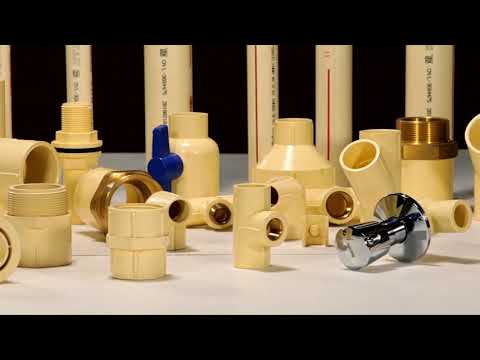

Product Usage Guide
Installation of Lifeline C-PVC Hot & Cold Water System - CTS Series